Chapelet Studio, products designed to last and to sell
Chapelet Studio was founded in 2008 in Cannes, in the south of France, by Stéphane Chapelet. Trained in product design in Toulon and then at IED (Istituto Europeo di Design), Stéphane Chapelet specialised in street furniture while still a student, then in urban planning in architecture firms, before putting this experience at the service of his own clients. Today the studio designs urban furniture, lighting, interior furniture, lamps and outdoor furniture. In interior and outdoor furniture, it designs products for manufacturers: the Linka sofa and Mikado chair for interiors, the Line and Ladeo seats for outdoor use.
Architecture, the first source of inspiration
The studio draws its inspiration first and foremost from architecture. Kinetic architecture, which creates visual movement, inspired the Gradient barrier. The cantilever principle gave rise to the Tila bench, whose concrete seat seems to float. The Crossed range is inspired by the branches on the facade of Toyo Ito's Tod's building in Tokyo. Toyo Ito and Zaha Hadid are among the studio's reference architects, as is Louis Sullivan with his principle: "form follows function".
Form follows function
The studio follows architect Louis Sullivan's principle: "form follows function". Every design starts from the client's brief. The work is about finding the right form and the right balance, always staying minimalist.
Strategy before design
Before drawing, the studio defines a sales strategy with its partners. Then come the concepts, and several functional and aesthetic solutions. The goal is to find the best compromise between quality, minimalism and simplicity of manufacturing.
All the work aims to optimise manufacturing: simplify and streamline processes, and so keep costs down. This method has produced several best-sellers, some of which sell several thousand units a year. More than 80 products are on the market today.
Some concepts come straight from research into optimising manufacturing. The Bold bus shelter joins extruded aluminium profiles with cast-iron connecting pieces. In Jeddah, the benches were drawn with a generous draft angle so they could be cast on site from exported moulds, rather than made in Europe and shipped.
From pencil stroke to product
Once the strategy is set, every product starts from a drawing. The studio always begins with a simple line, drawn in a single pencil stroke, then develops it while keeping its clarity and original intention, all the way to the finished product. This is a constant in its work: the Ladeo and Line seats, the Emme sunbed and the Lignes bench are examples.
Another principle: simple lines, but carefully worked details that give each product its personality. Finally, modularity is a studio signature: innovative products that combine with one another and evolve with changing needs, such as the Linka sofa, the Zadig bench and the S-Combo bench-planter, which combines with the Wave bench.
The sea and other inspirations
Based by the sea in the south of France, the studio also finds a strong inspiration in the sea, behind the Wave and Vague benches. Other products come from cars (Blade), origami (Zadig), the game of mikado (Mikado chair) or the wish to combine contrasting materials (Pure).
Projects around the world
The studio quickly won public tenders. In 2012, with Lab23, it delivered the Jeddah Corniche, won through a tender in Saudi Arabia: about 200 Emme benches and 100 Crossed bins in concrete, cast on site, along several kilometres of seafront.
In Monaco, it has led more than six projects, including the complete redesign of the port of Fontvieille, with Wave benches and Aveo planters in hypergranite (resin and quartz), as well as Sainte-Dévote and the Rainier III seawall. In Paris, it won the tender for Place de la Nation with Variations, an inclusive bench that welcomes able-bodied people and people with reduced mobility in the same place. In Marrakech, the Crossed bins were selected through a public tender.
In Barcelona, the studio designed the iGuzzini headquarters with the full Crossed collection and Horizon and Zadig benches. Its products also furnish the forecourt of the Milan Triennale, the maritime museum in Bergen and Hilton hotels in Canada, as well as sites in Capri, Venice, Alassio, Riga, Moscow and Miami.
Background
After a science baccalaureate and several years at art school (Beaux-Arts), Stéphane Chapelet discovered the product design course at the design school of the Lycée La Grande Tourrache in Toulon (class of 2001). Design brought together his passions for art, drawing and technology, in a course focused on the professional world.
In 2000, while still a student, he won first prize in the Acropose Design Trophy, a competition created by the street-furniture manufacturer Acropose to open students up to the professional world. His bike stand with an integrated lock holds the bicycle by its frame without bending the wheel. Acropose manufactured it and installed it in Vedène, Chambéry and Romans, and both Le Moniteur and Archi-Design reported on it. Street furniture became his speciality.
After a master's degree at IED (Istituto Europeo di Design), he specialised in urban planning in renowned architecture firms, on major urban projects, then founded his studio in 2008. Working with specialist European manufacturers, the studio has designed and brought to market more than 80 products, including several best-sellers such as the KJ luminaire, winner of the Design Plus Award. Its street furniture is installed in Paris, Jeddah, Barcelona, Milan, Venice, Monaco and Miami.
Today, Stéphane Chapelet also teaches at La Grande Tourrache, the school where he learned his craft.
The studio's manufacturers
The studio designs for European manufacturers who produce and sell its products.
Lab23 (Italy). Successor to Veneta Plastica, the company took the name Lab23 in 2008. It works with stainless steel, Corten steel, exotic wood, WPC and Hypergranite, a composite it developed. The studio has designed a large part of its collection, including the Crossed, Zadig, Wave, Variations, Lid, Kiosk, Wing, Emme and Horizon ranges: its website credits some fifty products to Stéphane Chapelet. Lab23 shows them alongside designs by Zaha Hadid, at Milan's Fuorisalone and MADE expo, and in the magazines Architettura del Paesaggio, Paysage / Topscape and L'Arca International.
Fontes de Paris (France). A leading public-lighting manufacturer, the company holds the Entreprise du Patrimoine Vivant label, and its heritage-style lanterns carry the Origine France Garantie label. Its luminaires light the Champs-Élysées, the Louvre and Place de la Concorde, among others. For Fontes de Paris, the studio designed the KJ luminaire, winner of the Design Plus Award, followed by Lumada and KJ-R.
MyWay (France). The concrete street-furniture brand of the Prefac group, made in France. The studio designed the Lignes and Tila benches for MyWay.
iGuzzini (Italy). The leading Italian lighting specialist sells the Crossed, Horizon and Zadig ranges made by Lab23 in Spain. The studio designed the grounds of its headquarters in Barcelona.
.Mdd (Poland). A major contract-furniture manufacturer, .Mdd makes the Linka modular sofa, one of the studio's best-sellers.
The studio also works with ARIA23, Lab23's outdoor collection (Line seat, Emme sunbed), H.Hansen (Nenufar tables), Martinelli (Mikado chair), Folks (Ladeo seat) and Déclic.
Awards and recognition
Acropose Design Trophy: first prize in 2000, for a bike stand manufactured by Acropose.
European ADREAM competition on eco-materials: finalist. The competition book published his Eco'seat bench, made of agro-materials.
Design Plus Award at Light + Building, for Fontes de Paris's KJ luminaire.
Lab23 and Zaha Hadid: in April 2013, Lab23 presented the studio's Zadig bench alongside Zaha Hadid's Serac bench at an evening event in Milan during design week.
In the press
As early as 2000, Le Moniteur des travaux publics et du bâtiment (issue 5041) and Archi-Design (issue 11) reported on Stéphane Chapelet's first prize in the Acropose Design Trophy. The ADREAM competition book later published his eco-designed Eco'seat bench in three languages.
In 2012, the Spanish magazine Diseño de la Ciudad (issue 82) devoted three pages to the Crossed range. In 2013, the international magazine Dezeen mentioned the Zadig bench in its article on Zaha Hadid's Serac bench for Lab23, and ArchiExpo's e-magazine featured the Emme bench in its Marseille special issue. In 2015, the Swedish magazine RUM selected the Corten steel Crossed bin, and the Italian magazine OFFICINA* named the studio among Lab23's designers, alongside Zaha Hadid. In 2023, the architecture magazine Archistorm (issue 121) published the Emme benches on Monaco's Rainier III seawall.
The studio's products have also been presented by their manufacturers in the Italian magazines Architettura del Paesaggio (Zadig and Emme, 2011), Paysage / Topscape (Crossed and Horizon) and L'Arca International (HyperGranit collection, 2016). They are listed on the leading international architecture and design platforms ArchiExpo and Archiproducts, and ArchiExpo interviewed Stéphane Chapelet in Milan in 2013.
Quality, durability and environmental awareness
The studio cares about the quality and durability of its products. It uses recycled materials wherever possible, such as the aluminium of the KJ and Lumada lights, made from recycled cans, and wood from FSC-certified forests.
A growing team
Working with a team of partners, the studio is growing and expanding internationally.
Where our products are installed
Cannes (France): the studio, since 2008.
Hefeng (China): Zadig benches, around 2011.
Jeddah (Saudi Arabia): Corniche, concrete Emme benches and Crossed bins, 2012.
Milan (Italy): Triennale, Zadig benches, 2012.
Riga (Latvia): Bench benches, 2014.
Monaco: since 2015, port of Fontvieille (Wave benches and Aveo planters in hypergranite), Rue du Portier (Blade benches), Rainier III seawall (Emme benches), Sainte-Dévote.
Canada: Hilton hotels, including the Hilton Lac-Leamy, Crossed furniture, 2015.
Marrakech (Morocco): Crossed bins, 2017.
Bergen (Norway): maritime museum, Zadig benches, 2018.
Miami (USA): concrete Bay benches, 2018.
Capri (Italy): Crossed seats and Zadig benches, 2019.
Paris (France): Place de la Nation, Variations benches, 2021.
Barcelona (Spain): iGuzzini headquarters, Crossed collection (benches, planters, bollards, bins), Horizon and Zadig benches.
Venice (Italy): Horizon benches.
Alassio (Italy): Bench benches.
Moscow (Russia): Zadig benches.
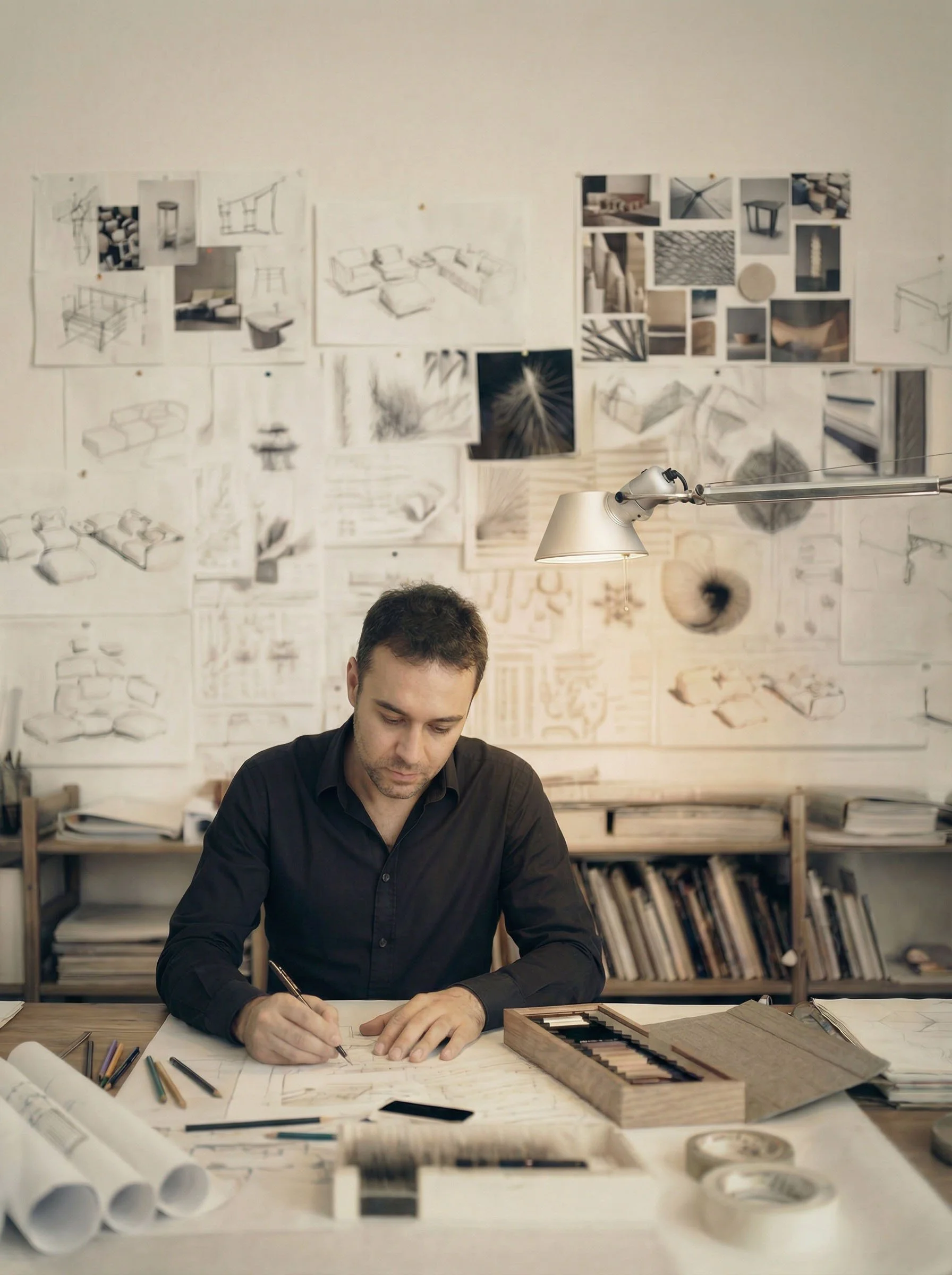
"The commercial success of the products created by Chapelet Studio results from the pursuit of precise design and optimized production, thanks to close collaboration with partners."